
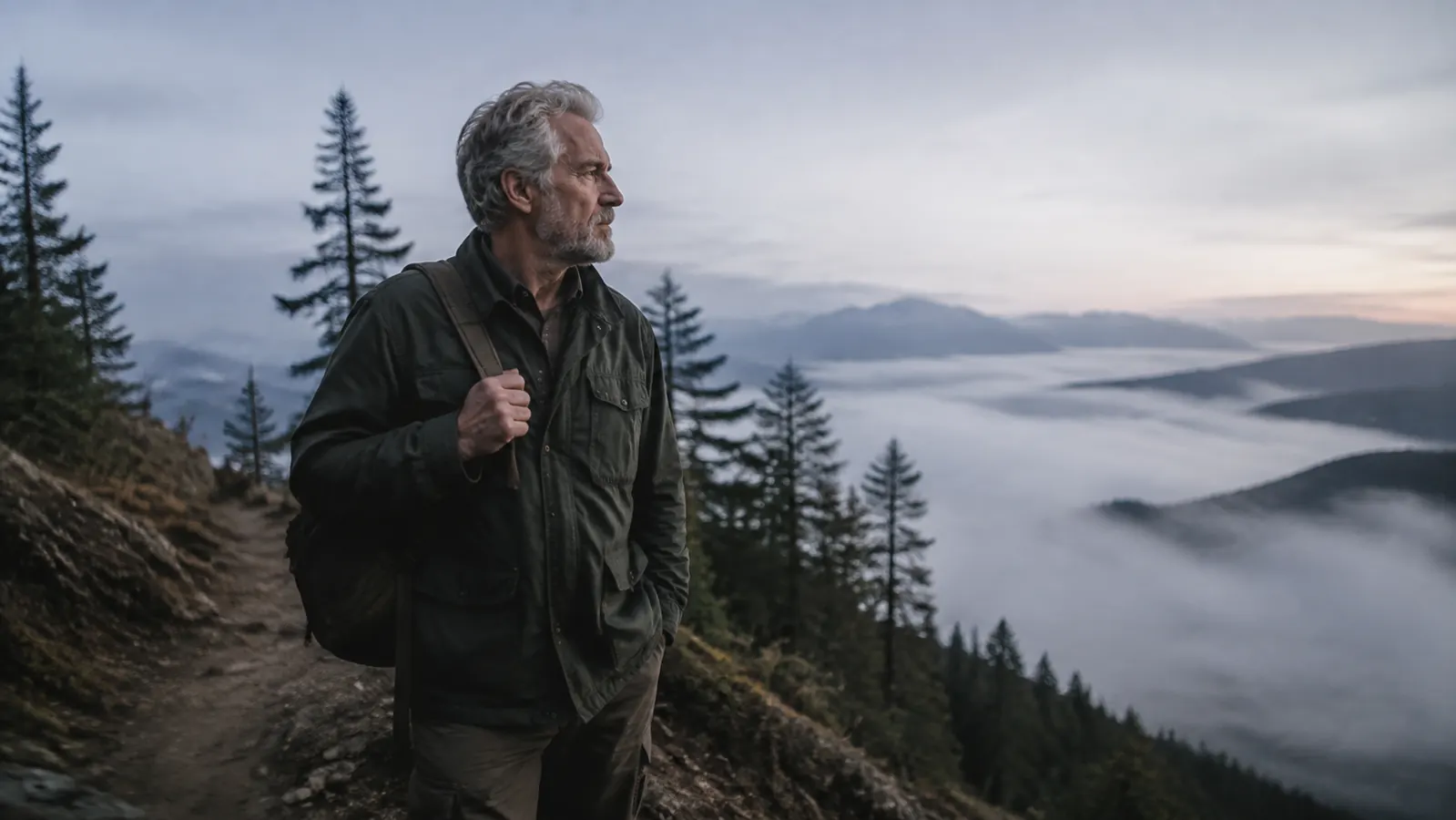
Every fall I tell myself this is the year I walk the ridge without limping home. Last October I finally stopped half-measuring it. I had a hinge brace for the bad days and nothing for the good ones, so I'd march up the old logging trail with a bare knee and pay for it every single time, usually around the second mile going down. My daughter bought me the Modvel two-pack for my birthday, and three seasons later it is still the first thing I reach for when the alarm goes off at 4:30. But the sleeve is only half of it. The other half is how you wear the thing, and I've got that part down to a routine that finally works.
The way I see it, a compression sleeve is like a good pair of waders. If you just slap it on and go, you'll spend the whole day fussing with it. But when you put it on right and treat it right after, it disappears. You stop thinking about your knee and start thinking about the deer sign on the far side of the ridge. That's the whole point of this article. I'm going to walk you through the exact five steps I use now, so you don't burn a season figuring it out the slow way like I did.
Why the Ridge Chews Up a Knee Worse Than a Flat Walk
Here's what sixty-ish years of walking taught me. Going up, your knee carries your whole body weight on each step, and going down it works like a brake, and that brake is where the trouble starts. On flat ground the knee barely raises a sweat. On a steep descent with loose gravel and wet leaves, every step is a little jarring stop, and you stack a couple of thousand of those before lunch.
The ridge behind my place is three and a half miles each way with about nine hundred feet of climb, and the top third is a rock-strewn track that bounces every pound of you back with interest. That's why a bare knee only made it to October before I admitted things. The Modvel sleeve doesn't rebuild anything, let's be straight about that, but the compression takes the edge off, and more than that it makes me move the way I should instead of the way I'm tempted to.
The Sleeve That Took the Edge Off Three Seasons of Ridges
I've worn the Modvel two-pack for three seasons now, and it's the piece of gear I'd buy again first. It's got more than 80,000 reviews on Amazon and a steady 4.4 rating, which in my book beats a lot of fancy names. Plenty of mornings I wear one while the other hangs on the line drying.
Amazon Check Today's Price on Amazon →Step 1: Put It On Before You Need It, Not After
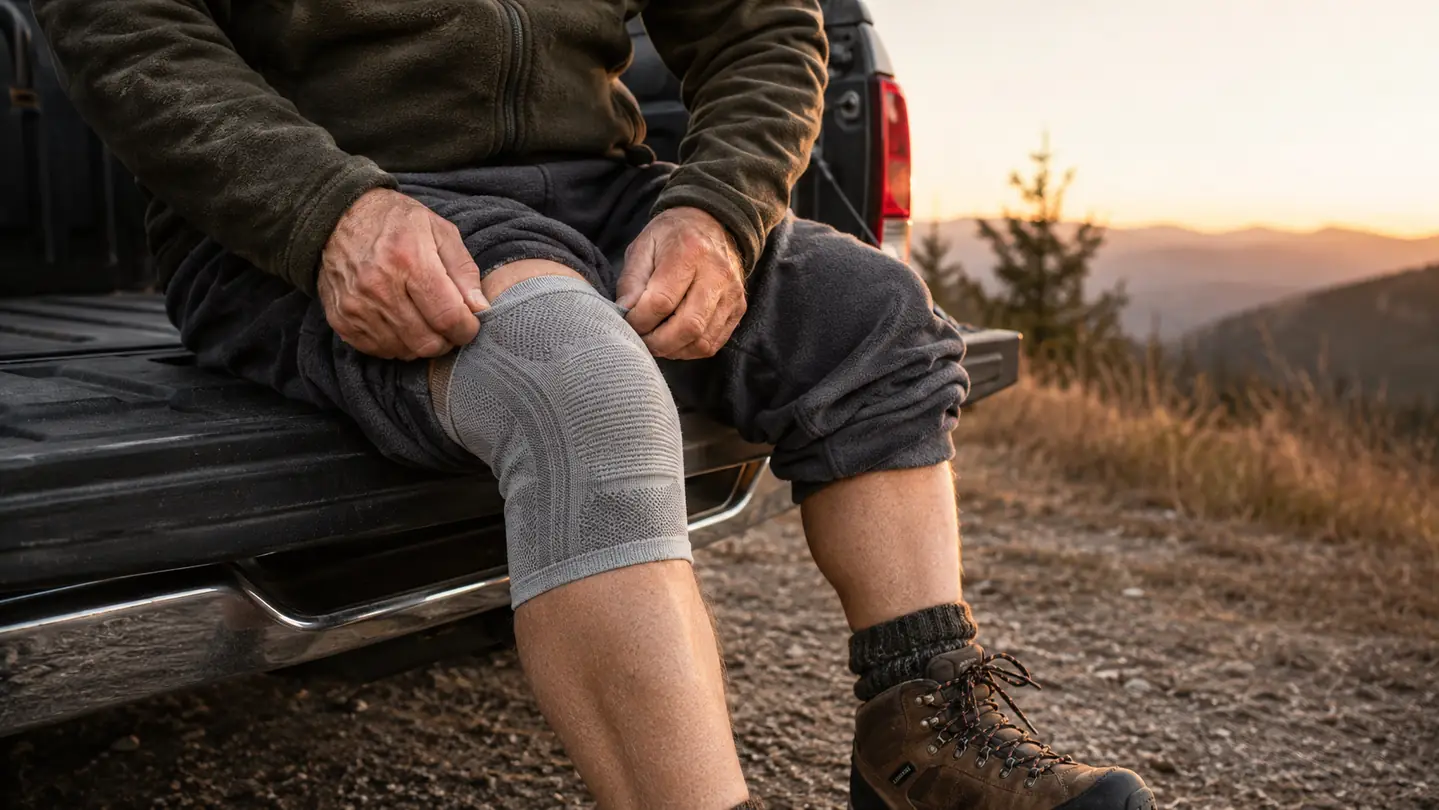
The biggest mistake I made the first fall was wearing the sleeve on the way back. I'd start bare and then, at the top, when the knee was already cranky, I'd try to pull the thing over a sweaty leg and up a tired joint. That never worked. Now the sleeve goes on at the truck, before first light, while the knee is still cool and the leg is dry. Five minutes of prep saves me an hour of limping. Compression works best when it's on before the joint gets tired, the same way you'd rather have rain gear on before the squall hits, not after.
In the cold months the sleeve doubles as a little warm blanket on the joint, and I've come to believe that warmth is half the job. There's a reason a knee that's fine at noon complains at 5:30 on a November morning. So I let the truck run long enough to get heat in the cab, I do the sleeve up in the dry warmth, and I give the knee a couple of minutes to take the temperature up before I step into the cold. It's not science I can quote you, but it keeps me honest on mornings when the alarm reads a number that should be illegal.
I keep the Modvel in the driver's door pocket with the knife and the headlamp, so there's no decision to make in the dark. If the weather says the walk is on, the sleeve goes on. That might sound like a small thing, but the knee doesn't care about your reasons for skipping it, it just cares whether you showed up. It plays the long game. So do I now.
Step 2: Fit It Like You Mean It, No Bunching Behind the Knee
The sleeve needs to sit smooth and snug, with the top edge even and no pocket of air or bunch behind the joint. When I half-slept through putting it on the first time, the fabric wrinkled right in the crease behind my knee, and within a mile it started biting and sliding. That's how you end up yanking at it on the trail, which is exactly what I'm trying to avoid. Take the extra fifteen seconds to pull it up evenly and smooth it flat. If it feels looser than a firm handshake, it's too loose, and if it's cutting off circulation you'll know it before you reach the first bend.
What sold me on the Modvel is the open area behind the knee. A lot of the older sleeves I tried were one solid tube that trapped heat and rolled down the moment I started sweating. These don't. They breathe, they stay where I put them, and because the pack comes with two, I always have a dry one. The morning after a wet walk I hang one on the line and grab the other, so one is never soaking and cold. That rotation is half of why they're still in good shape in season three.
The day I put the sleeve on before the knee asked for it is the day the ridge stopped being a battle and started being a walk.
Step 3: Walk the First Ten Minutes Like a Warm-Up, Because It Is
Here's what nobody tells you about compression: it isn't instant. You put the sleeve on and expect the knee to feel perfect out of the gate, but for me the first ten minutes are still the stiffest of the day, especially in October, especially in the cold. So I don't judge the walk by the first ten minutes anymore. I take the flat approach to the ridge slow, easy strides, arms swinging, and let the legs come around. Somewhere around the ten-minute mark the stiffness thaws, the knee settles in, and that's when the real walk starts.
And that's when I can feel the sleeve earning its keep. It's steady pressure, gentle and constant, and after twenty or thirty minutes my right knee just stops being the thing I'm thinking about. I've stopped counting the miles in complaints. If you're brand new to sleeves, give it a week before you judge it. The first day out it'll feel odd, like a new boot, and by day five you'll forget it's there, which is exactly the point.
Step 4: Steer the Downhill, Don't Let It Steer You
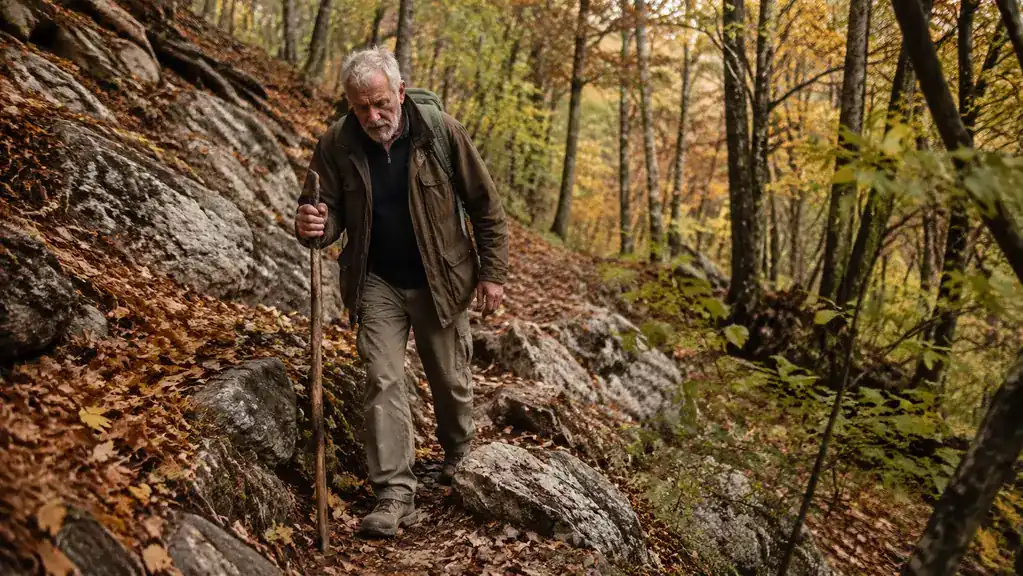
The downhill is where the sleeve pays for itself, and also where a lot of guys wear one and still hurt, because they let gravity run the show. The pressure gives you feedback, a steady little reminder of where the knee is and how it's tracking, but you've got to listen to it. I shorten my stride on the way down and let my legs do the braking instead of my knee. Little steps, feet nearly under me, heel down first. It feels slow next to the way I used to bound down, but I'm not racing anybody, and I get home without the long stove-up evening that used to follow.
A walking stick helps more than a man my age wants to admit, and between the stick and the sleeve the descent turns back into just walking. If the trail is wet I pick a route with good footing instead of charging the straight line. The sleeve will keep the joint company, but it's not a spare knee, and I respect that difference. That honesty is the whole reason this routine has held up. I don't ask the sleeve to fix me. I ask it to hold things steady while I do the smart part.
Step 5: Air It Out and Rotate It, Like Any Gear You Value
The sleeve works hard all day, and it holds sweat the way a good dog holds a bone. When I get home I slip it off and lay it flat on the table to air, or over the porch rail if the sun's out, and grab the second one from the pack for the next morning. Washing it is simple: cool water, mild soap, no dryer. I ruined the first sleeve I ever owned by throwing it in the dryer once, and it came out puckered and sad. These two have been treated kindly, and that's why they're still doing their job in year three.
I also rinse the skin behind the knee and dry it before I put a fresh sleeve on. Chafing is the enemy of long mornings, and clean skin lets the compression do what it's supposed to do without a few days off from a rubbed spot. It sounds fussy described like this, but it's two minutes at the end of the day that buys me a comfortable tomorrow.
What the Sleeve Won't Do
Let's be honest, the way a guy at the bait shop talks. The Modvel sleeve won't cure a worn knee, because nothing on a shelf cures a worn knee, and I'll side-eye anyone who tells you different. It won't hold a joint together if something is genuinely torn; that's a doctor's conversation. What it does, day in and day out, is take the edge off, keep the knee warm and steady, and help me move the way I should. For me, that's the difference between walking the ridge and just remembering it, and knowing the difference is what's kept me out there.
What Else Helps
I pair the sleeve with a short list of things that cost nothing and pay off every trip. I walk ten easy minutes a day for the week before a big hunt, so no walk out of the blue. I stretch the quads and hamstrings at the truck, thirty seconds each side, before the first step. I keep a walking stick in the truck bed for the descent. And I don't walk the ridge the day after a long hard hunt unless I'm feeling good, because an already-tired knee is the one that nags for the rest of the week.
But the sleeve is the piece of kit, the one that shows up in every photo from every trip. If you've been putting off the walk because the knee's been talking, a good compression sleeve is the cheapest piece of insurance I know of. It won't rebuild the joint, nothing will, but it will let you stand at the top of the ridge in the cold gray light and watch the valley come awake, and that feeling is the whole reason we keep going.
And one more thing, the one I forget most often. The sleeve is not permission to go stupid. On days when everything aches, ibuprofen and a shorter loop beat pride and a six-mile walk every time, and that's coming from a man who had to learn it twice. The ridge will still be there next week. It's been there for a hundred years. What matters is that you're still the one standing on top of it.
Stop Letting a Cranky Knee Pick Your Hikes for You
Three seasons later I still reach for the Modvel two-pack first. More than 80,000 reviewers say it's worth a shot, and at today's price on Amazon it's hard to argue against trying one before your next trip up the ridge.
Amazon Check Today's Price on Amazon →